Brutalè — From Food Waste Cost to Recoverable Value
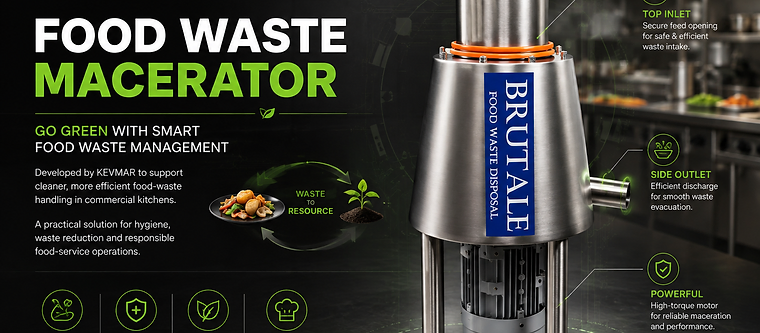
KEVMAR developed Brutalè as a cost-effective local alternative to imported food-waste macerators. While the immediate benefit was cleaner and more practical food-waste handling in commercial kitchens, the broader opportunity emerged in what processed waste could become: a more controlled output that may support composting, worm farming and other recovery opportunities, with some applications potentially extending into animal-feed pathways subject to the necessary legal, hygiene and processing requirements.
The Problem
Commercial kitchens generate food waste that is unpleasant to store, costly to handle and often ends up in black plastic bags and smelly bins. Imported food-waste maceration equipment offered a cleaner route, but the capital cost could be difficult to justify in a restaurant already carrying a high setup cost.
The Constraint
Brutalè needed to be a practical, locally manufactured alternative to imported equipment, but the market economics were just as important as the engineering. Restaurants often prioritised essential opening costs and deferred waste-handling equipment, while building owners and companies with stronger environmental objectives were more willing to invest in a reusable waste-management solution.
The Thinking
KEVMAR developed Brutalè to reduce dependence on imported food-waste equipment and make on-site waste processing more commercially accessible. The experience also exposed a larger question: instead of treating processed food waste as something to dispose of, could the system recover value from it? A later all-in-one concept was designed around taking the waste, breaking it down, separating the liquid from the solids and depositing the solid fraction into a bin. That direction opened the door to broader value-recovery opportunities such as composting, worm farming / vermiculture, and potentially animal-feed pathways such as pig feed, provided the downstream use meets the necessary legal, hygiene and processing requirements. The technical concept was achievable; the unresolved challenge was whether the value recovered from the by-product could justify the added equipment and processing cost.
The Solution
Brutalè was developed as a locally manufactured food-waste macerator for commercial kitchen use, combining a fabricated stainless-steel structure, mechanical processing components and assembled hardware into a complete product. The next-stage concept extends that thinking toward integrated separation of liquids and solids so the output can be handled as a more controlled recoverable material rather than simply as wet food waste.
How It Was Manufactured
A mixed-process product-development project using fabricated stainless steel, CNC/laser-cut components, mechanical drive elements and final assembly. The integrated solids-and-water separation system remains a development concept rather than a published production claim.
The Result
Brutalè demonstrated that KEVMAR could develop a credible local alternative to imported food-waste processing equipment. Sales were strongest where building owners or environmentally minded operators placed real value on cleaner waste handling and sustainability, while many standalone restaurants continued to choose lower-capital disposal methods such as plastic bags and bins. The bigger long-term opportunity sits beyond the machine itself: can food waste be processed into a more useful by-product with enough downstream value to change the economics of the system? Opportunities such as composting, vermiculture and other recovery models may become commercially important if the full process can be made technically and economically viable.
Your problem could be the next case study.
Bring us a component, an idea or a manufacturing challenge. If we solve it, we'll tell the story properly.