
When the part works poorly, costs too much, or uses the wrong material — redesign it.
For components that function badly, are difficult to manufacture, use unsuitable materials, or could simply be produced more efficiently. We focus on manufacturability, performance, material choice, cost, repeatability and commercial practicality.
A redesign only works if it holds up against six questions.
Manufacturability
Can it actually be made efficiently, or is the design fighting the process?
Performance
Does it do the job properly in the real world, not just on paper?
Material choice
Is the current material the right one for the application and the process?
Cost
Can the unit cost come down without sacrificing function?
Repeatability
Will it be consistent across every production run?
Commercial practicality
Does the redesigned part make commercial sense to produce locally?
Redesign isn't about making it look different. It's about making it work better and cost less.
We look at why a part is failing or costing too much, then redesign it for the manufacturing method that makes the most sense locally. Sometimes that means changing the geometry. Sometimes the material. Sometimes the whole approach.

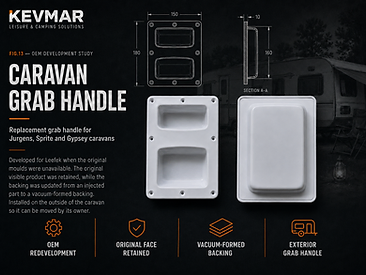
Got a part that's costing you too much?
Let's look at it together. Sometimes a redesign pays for itself faster than you'd expect.