When you can't get the part, manufacture it locally.
For components that are imported, unavailable, obsolete, discontinued, subject to long lead times, or tied to unreasonable minimum quantities — we start from whatever exists and find a practical route to local manufacture.

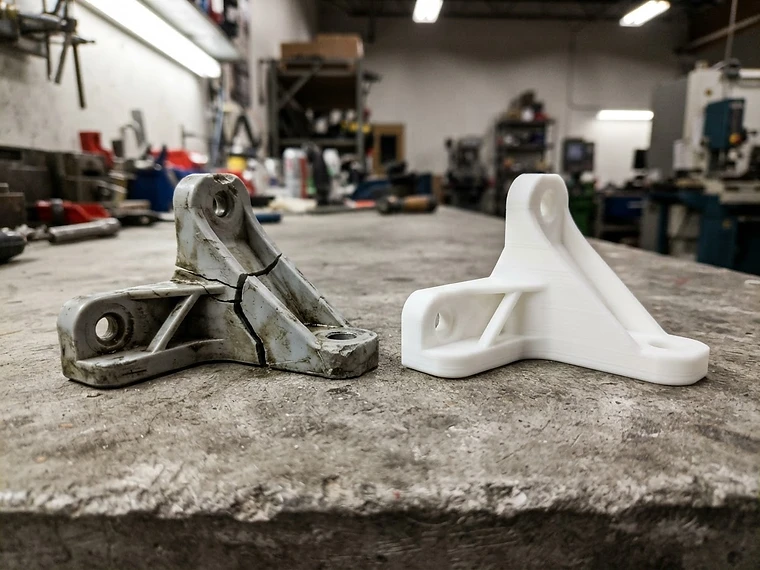
We start from what exists — not from what's missing.
You don't need a perfect drawing. You need the part, or evidence of it. From there we reverse engineer the geometry, identify the material, assess the function, and determine the most practical manufacturing method to produce it locally.
Any of these is enough to begin.
An existing component
Working or otherwise — we can measure and reproduce it.
A damaged or broken part
Even fragments tell us a lot about the original.
A photograph
A few clear photos are often enough to begin.
A sample
Physical samples reveal material and geometry.
A sketch
Hand-drawn dimensions and notes are a valid starting point.
A drawing
Engineering drawings speed up the process considerably.
A CAD file
Existing models let us move quickly to manufacture.
A specification
A written spec or bill of materials gives us a clear target.
An imported product
We can reverse engineer and produce it locally.

Can that part actually be made locally?
Can you manufacture a replacement component from an existing sample?
In many cases, yes. A physical sample — even a damaged one — is often enough to reverse engineer the geometry, identify the material and determine a practical local manufacturing route.
Can an obsolete plastic component be manufactured locally?
Often yes. If the original part is discontinued or no longer available, we can reproduce it locally, provided the function and material can be established from what exists.
Can an imported plastic component be replaced with a locally manufactured alternative?
Frequently yes. We reverse engineer the part and produce it locally to reduce lead times and avoid minimum-order quantities that don't suit the requirement.
What if the original mould or tooling no longer exists?
We can recreate a manufacturing route — sometimes using a different process — so the part can be made again without the original tooling.
Can KEVMAR work from a photograph, sample or sketch?
Yes. A few clear photographs, a physical sample, or a hand-drawn sketch with dimensions are all valid starting points. A drawing, specification or CAD file speeds things up further.
Have a part you can't source?
Send us what you have — a component, a photo, a drawing, or even a description. We'll tell you if it can be made locally.